Digital Public Infrastructure for
Protein Structure Prediction
A governed, multi-tenant platform that exposes AlphaFold-grade predictions as shared scientific infrastructure — for research institutions, labs, and computational biology pipelines.
Shared infrastructure for structural biology.
What it does
Wraps the prediction engine — AlphaFold-based, classifies proteins as Metamorphic or Monomorphic — behind a stable, multi-tenant API surface.
Who it serves
Research universities, hospital labs, and computational biology pipelines that need governed access to high-quality fold predictions.
How it's governed
A four-role DPI model: Platform Admin, Organization Admin, Provider, and Consumer — each with scoped permissions and audit trails.
Four roles. One infrastructure.
Every interaction with the Protein Synthesis DPI happens through one of four scoped roles. Pick one to enter that role's dashboard.
Overall platform controllers and system governance.
The platform root administrators. They govern the entire global ecosystem: managing tenant organization subscriptions, reviewing security logs, monitoring total server workloads, and managing root API credentials.
- Manage and verify all registered organizations
- Issue, rotate, and decommission publishable API keys
- Monitor global cluster hardware uptime & latency
- Review platform-wide security audit logs
- Toggle maintenance lockouts and config defaults
Local coordinators for specific universities or labs.
Administrators representing an institution (e.g. Stanford). They manage their lab's quota allocations, authorize or invite researchers, check monthly credit spending, and configure completed prediction webhooks.
- Invite researchers and configure accounts
- Manage user limits (job limits, monthly caps)
- Review credit usage charts and download invoices
- Onboard organization-level computation nodes
- Set webhook endpoints for automated model reports
Compute owners and machine learning teams.
The node providers operating GPUs and prediction servers. They plug their machines (running AlphaFold, ESMFold, etc.) into the DPI, setting visibility levels and tracking their api performance.
- Register new structural prediction models & versions
- Configure REST, GraphQL, or gRPC endpoint access
- Choose access settings: Open, Restricted, or Paid
- Inspect API usage counts, latencies, and error rates
- Check active cluster node health and VRAM load
End-user biologists, chemists, and pipelines.
The primary users who run folds. Biologists, pharmacologists, or client scripts submit amino acid FASTA strings to get folded 3D coordinates, review prediction scores, and export PDB structures.
- Input or paste FASTA sequences
- Monitor queue progress in the Researcher Portal
- Inspect folded 3D models with pLDDT heatmaps
- Download structure files (PDB, FASTA, JSON format)
- Trigger automated batches using client SDKs
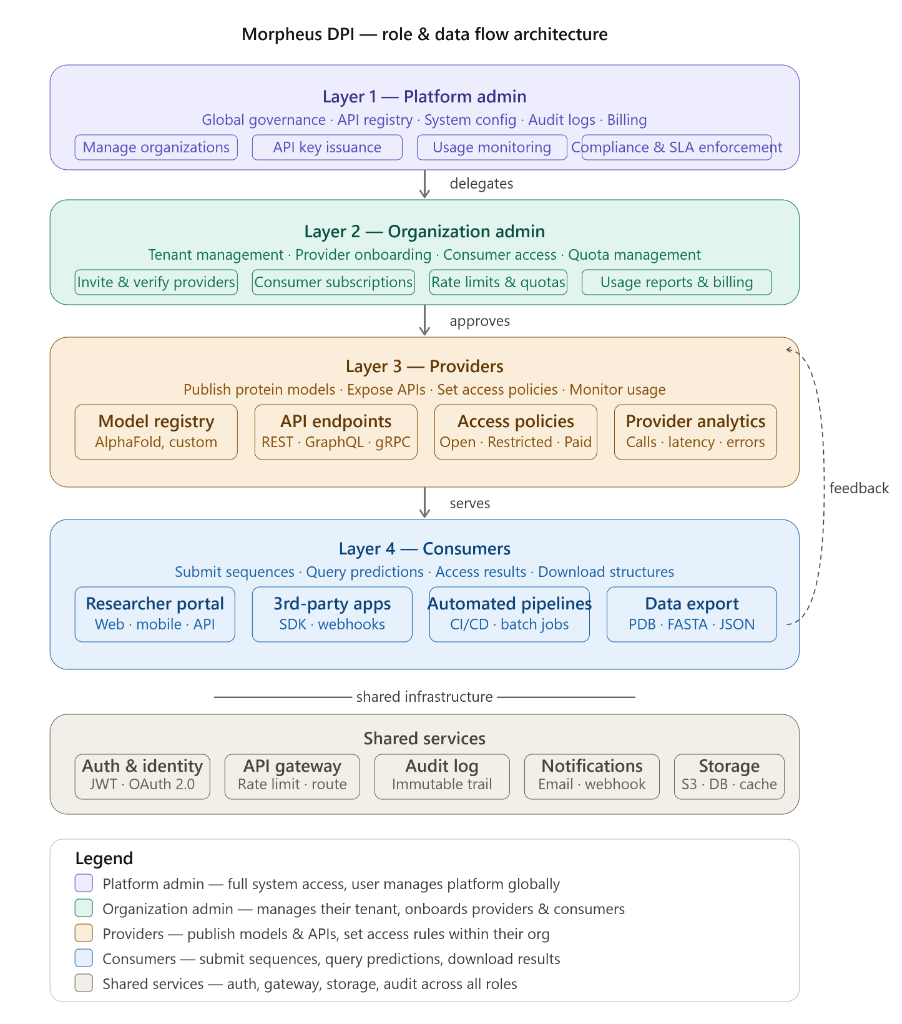
Role & Data Flow Architecture
The protein synthesis DPI operates as a layered scientific ecosystem. The architecture guarantees clean data flow from consumer requests down to backend GPU resources, governed by audit logs and tenant limits.
Platform Admin (Governance)
Orchestrates organizations, issues secure API keys, reviews system config, and audits access logs.
Organization Admin (Tenant Management)
Onboards providers and manages consumer subscriptions, rate limits, quotas, and invoices.
ML Providers (Model Compute)
Hook up folding prediction engines (AlphaFold/ESMFold), set open/paid visibility, and watch runtime analytics.
Consumers (Scientific Researchers)
Submit FASTA sequences via the portal or 3rd-party apps, check folds, and download PDB files.